A Response to the Coronavirus
It’s something that we like to think of as only happening in the history books, that with all our advancements in technology and medicine, it certainly can’t happen to us here and now - that a disease could sweep through a community and cause such serious illness, death, isolation, economic loss and fear. But as we hear the reports about the spread of the coronavirus and feel its devastating effects in big and small ways, we are once again reminded how fragile we are.
It’s something that we like to think of as only happening in the history books, that with all our advancements in technology and medicine, it certainly can’t happen to us here and now - that a disease could sweep through a community and cause such serious illness, death, isolation, economic loss and fear. But as we hear the reports about the spread of the coronavirus and feel its devastating effects in big and small ways, we are once again reminded how fragile we are.
Our community was first made aware of the virus through some of our sisters who have family in Vietnam and reported that the streets were deserted during the Asian New Year - people dashed out only when absolutely necessary, donning masks as they went, and then hurried home again. Then we learned through our friars that travels to and from Europe were being postponed or canceled. News and prayer requests came in as family and friends located around the country and the world were being affected in various ways - sickness, isolation, economic hardships due to disruption or loss of business, and fear of the unknown.
It is at times like this that a cloistered nun is impelled to more closely unite herself to her Divine Spouse and, like Queen Esther, intercede more ardently for the life of her people.
Some may mistakenly believe that we are isolated from all the suffering of the world, locked inside the security of cloister walls. But as Queen Esther realized, being inside a palace does not guarantee safety from affliction and distress - rather, it places us in a more unique position to intercede for the needs of others. We are deeply aware of our blessings - to continue to have the gift of daily Mass and reception of the Eucharist, to spend time in prayer and adoration before our Eucharistic Lord - these and many other graces are gifts people around the world deeply long for and cannot receive at this time, or even worse, they do not realize the infinite treasure of these things and so do not desire them.
And so, as cloistered nuns, we feel more keenly the isolation, the fear, the suffering of all, and we carry these sufferings in our heart before our Lord in prayer…
…especially during the liturgy, our reception of the Eucharist, and our time of adoration before the Blessed Sacrament. We remember the sick and those most vulnerable - our young and our elderly. We remember those who care for them. We beg protection for chaplains and ministers who reach out with God’s mercy to those most in need. We also intercede for medical personnel, first responders and for their families. We ask for knowledge and wisdom on behalf of medical researchers and developers and our civil leaders. We lift up in compassion those experiencing loneliness, hardships and temptations to frustration, anxiety and fear as schools and businesses close, people are compelled to remain homebound, or are stranded away from home and loved ones as travel and movement are increasingly restricted. And we remember the souls of the departed that they might be granted eternal rest and their loved ones will be consoled.
In faith, we know that our remembrance and our prayers have powerful effects across the body of Christ - when one member suffers, all suffer, and when one member rejoices, all rejoice. Our contemplative life is wholly apostolic in that we implore God’s grace on behalf of all people. For when the hands and feet of Christ - that is, his priests, apostolic religious and laity - are shackled from service, cloistered communities, as the heart of Christ, burn more ardently with His love. And this love and grace knows no boundaries of space or time - it reaches through walls, across continents, and can pierce and warm the hearts of those most in need of consolation and mercy. This is why the contemplative life is considered the heart of the Church and its most noble part.

Saint Rocco, patron against the plague and epidemics, is pictured here with a plague sore on his leg, the angel who brought him healing and a promise from God, and the dog who brought him food every day while he was ill.
As news of the gravity of this disease and its spread reached us, one of our sisters shared with the community a saint and a prayer that her mother taught her to pray against epidemics. St. Rocco has long been venerated in the Church as the protector against the plague and all contagious diseases. Coming from a life of privilege, he forsook all to become a pilgrim. During his travels, he came in contact with a community ravaged by the plague and when no one else would serve the sick for fear of catching the deadly disease, he took up the burden. Eventually he too fell ill with the plague and went into the woods to die a hermit. But the dog of a nobleman brought him food everyday and eventually the nobleman, wondering where his dog was going, followed him and discovered Rocco. He brought him out of the woods, gave him proper lodging and Rocco miraculously recovered. His story continues, but because of his selfless mercy and miracles attributed to him, particularly after his death, he is considered a powerful intercessor against epidemic diseases. We share the prayer with you below that our sister shared with us. May our Blessed Mother and Saint Rocco intercede for us. Lord, have mercy on your people us.
Prayer to Saint Rocco
O Lord, you promised that those who run to Saint Rocco and implore his intercessions will be delivered from all epidemics, and you sent an angel to write this promise on a scroll and give it to him. We beg you to preserve our bodies from contagious diseases and our souls from the contagion of sin, by the merits and intercessions of Saint Rocco. Amen.
UPDATE:
EFFECTIVE MARCH 17, 2020:
Due to the “Shelter-in-Place” Order
issued by the Health Officer of San Mateo County
on March 16, 2020, our chapel is currently closed to the public.
During this time of social distancing, we encourage you to keep up your spiritual life by “attending” Mass online (such as the daily Mass being offered by Bishop Barron), reading and meditating on Scripture (daily readings available in print and audio at the USCCB website), making frequent spiritual communions, praying the Rosary and the Divine Mercy chaplet and prayers, and taking advantage of other online and app faith resources - a wonderful list of linked resources may be found online at the Western Dominican Province’s website.
Please know our community is especially keeping you in our hearts and prayers before the Blessed Sacrament during this time.

Ashes, Dust and Love
Penance. Suffering. Ashes and dust. It’s that time of liturgical year again. So what is the season about? Is it merely to inflict pain and punishment, to make us feel bad about ourselves and our sins? To bring gloom and doom down on us as we are reminded “you are dust, and to dust you shall return”? Certainly if we were a people without faith in a God of mercy and love, without hope for life with Him in heaven, then Lent would indeed be very dark. But we are ultimately an Easter people…
Penance. Suffering. Ashes and dust. It’s that time of liturgical year again. It’s Ash Wednesday. The beginning of Lent. Many of us have a love/hate relationship with this penitential season. We enter into with different levels of commitment. Some of us get pretty creative in our fast and penitential practices to ease into it and slide through. After all, it is innate in us to avoid suffering and seek pleasure. Yet, there is something about the season of Lent that speaks to us on a deeper, more profound level. We NEED it, even if we aren’t sure exactly what to do or how to go about getting the most spiritually out of the season. So, often it stretches before us, six weeks of purple.
So what is the season of Lent about? Is it merely to inflict pain and punishment, to make us feel bad about ourselves and our sins? To bring gloom and doom down on us as we are reminded “you are dust, and to dust you shall return”? Certainly if we were a people without faith in a God of mercy and love, without hope for life with Him in heaven, then Lent would indeed be very dark. But we are ultimately an Easter people, a people of joy and hope and love. Nonetheless, to fully live Easter, we must walk through the passion and death of Christ Jesus, precisely because of sin.
In the creation of Adam and Eve, God made man unique. While we have bodies like the animals, we also have a reason and a will – we are rational creatures. And God gave humans a gift – so long as the mind of man remembered who He was (a creation of God) and remained obedient to Him, then the lower powers of man (his bodily senses and passions) would remain subject to his will and death would be foreign to us. But when Adam and Eve saw the forbidden fruit was good for food, pleasing to the eye, and desirable for wisdom, then took the fruit and ate it, they grabbed at God’s place – they rebelled against the order of creation. Now the carnal appetite of humankind rebels against the spirit and death is the result. Our reason is darkened, our bodies and passions often seek to assert themselves against what we otherwise would will. The forbidden fruit seemed good as food – now we are prone to sins of the flesh (gluttony, lust, sloth). The forbidden fruit was pleasing to the eye – now we are prey to lust of the eyes (greed and envy). And the forbidden fruit was desirable for wisdom – now we puff ourselves up with pride and vainglory and seek to dominate others through wrath.
Fast forward to Jesus. Immediately after Jesus’ baptism, the Holy Spirit drove Him into the desert for forty days and nights – a time of prayer and fasting. It was in the desert that Jesus was tempted by Satan to sin. In His responses to Satan, Jesus shows us how to respond in freedom. Jesus was tempted to turn stones into bread and satisfy His fleshly hunger. He responds, “Man does not live by bread alone.” Jesus was taken to the top of the temple and told to prove He was to Son of God by jumping off – after all, God promised to catch Him (Satan even quotes Scripture in this temptation). But this was a temptation to pride. Jesus answers with humility – “you shall not put the Lord, your God, to the test.” Finally, Jesus was led to a mountaintop and shown the world – it would all be His, if He would just do homage to Satan – a temptation to grab power and possessions, so pleasing to the eye. But at what cost? Jesus says, “Get away, Satan! It is written: The Lord, your God, shall you worship and Him alone shall you serve.”
In the practice of prayer, we are reminded that God is “He who is” and we are those who are not. That is to say, as we grow in relationship with God through prayer, we come to see more clearly the truth about God and ourselves. We grow in humility, charity, and all the virtues as He pours His grace out upon us. But we have to open ourselves up to Him and we do this through prayer.
Through the practice of fasting, penance and mortifications, we bring the body and passions back into subjection to our reason and will. Like a spoiled child that has to be disciplined and trained, our senses, carnal desires and passions need to be purified and brought back into right order. Of course, we can only do this with God’s grace. We are also reminded how weak and helpless we are apart from God. We cannot rely on our own strength – though we work and strive as if it all depends on us, we pray for God’s help and abandon ourselves to Him as if it all depends on Him.
Finally, though almsgiving, that is, the corporal and spiritual works of mercy, we become detached from the things of this world and freed from the sins of greed and envy. We stop worrying about what tomorrow will bring because we learn to trust God’s providence, while at the same time growing in charity toward our neighbors.
Lent is not about punishing ourselves. It is not God’s intent that we simply suffer, as if that were the goal in itself. In St. Catherine’s Dialogue, she repeatedly records God telling her that suffering is NOT a proper goal. Prayer, penitential acts and works of mercy are only worth anything at all because they spring from, are rooted in, and lead to love. So if our Lenten practices are not leading us deeper in relationship with God, helping us do good and avoid sin – in a nutshell, aiding us to more perfectly keep the commands to love God and neighbor – then we need to go back, reassess and adjust our practices.
So, how do your practices of prayer, penance and almsgiving help you love God and neighbor? How can we grow in holiness this Lent? How can we better prepare ourselves to welcome Jesus, like a bride greeting her beloved, on Easter morning?

Beautiful Preaching: Fra Angelico, the Arts and Iconography
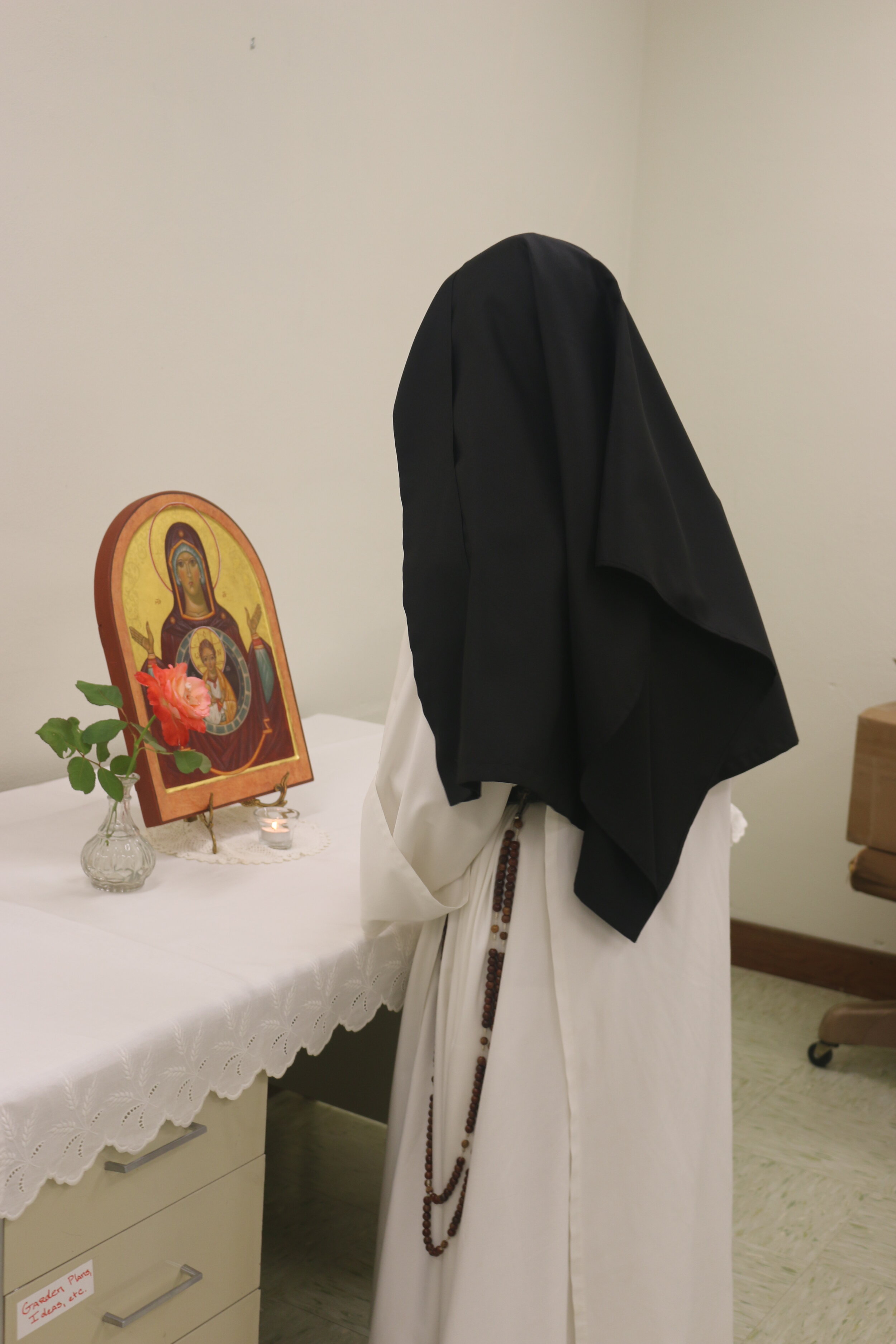
Fra Angelico was an examplar Dominican preacher - he sought the face of God in contemplation, gave Christ his entire being and became an instrument in His hand to preach the Gospel and draw people to Himself through the beauty of his paintings and frescoes. This too is the way for the nuns of the Order of Preachers. Our community has, from its beginning, had a tradition in the visual and musical arts, which has blossomed through the course of time in various ways: producing vestments and ecclesiastical linens, Gothic calligraphy and illuminating manuscripts, fine artwork, photography and digital design, and most recently iconography.
To preach the Gospel, words are not always necessary. Today we remember a Dominican friar who remains one of the most renowned artists of all times: Blessed John of Fiesole, more popularly known as Fra Angelico. Fra Angelico was known to frequently say, “If you seek to do the work of Christ, you must live with Christ.” Fra Angelico was an examplar Dominican preacher - he sought the face of God in contemplation, gave Christ his entire being and became an instrument in His hand to preach the Gospel and draw people to Himself through the beauty of his paintings and frescoes.
This too is the way for the nuns of the Order of Preachers. And as each individual is given charisms for the building up of the Church, it is not uncommon to find monastic communities have general charisms as well, both for preaching some particular aspect of the Gospel and often to help support the community: some communities excel in gardening and the use of natural resources, some in various crafts and the production of goods, and so on. Our community has, from its beginning, had a tradition in the visual and musical arts, which has blossomed through the course of time in various ways: producing vestments and ecclesiastical linens, Gothic calligraphy and illuminating manuscripts, fine artwork, photography and digital design, and most recently iconography.
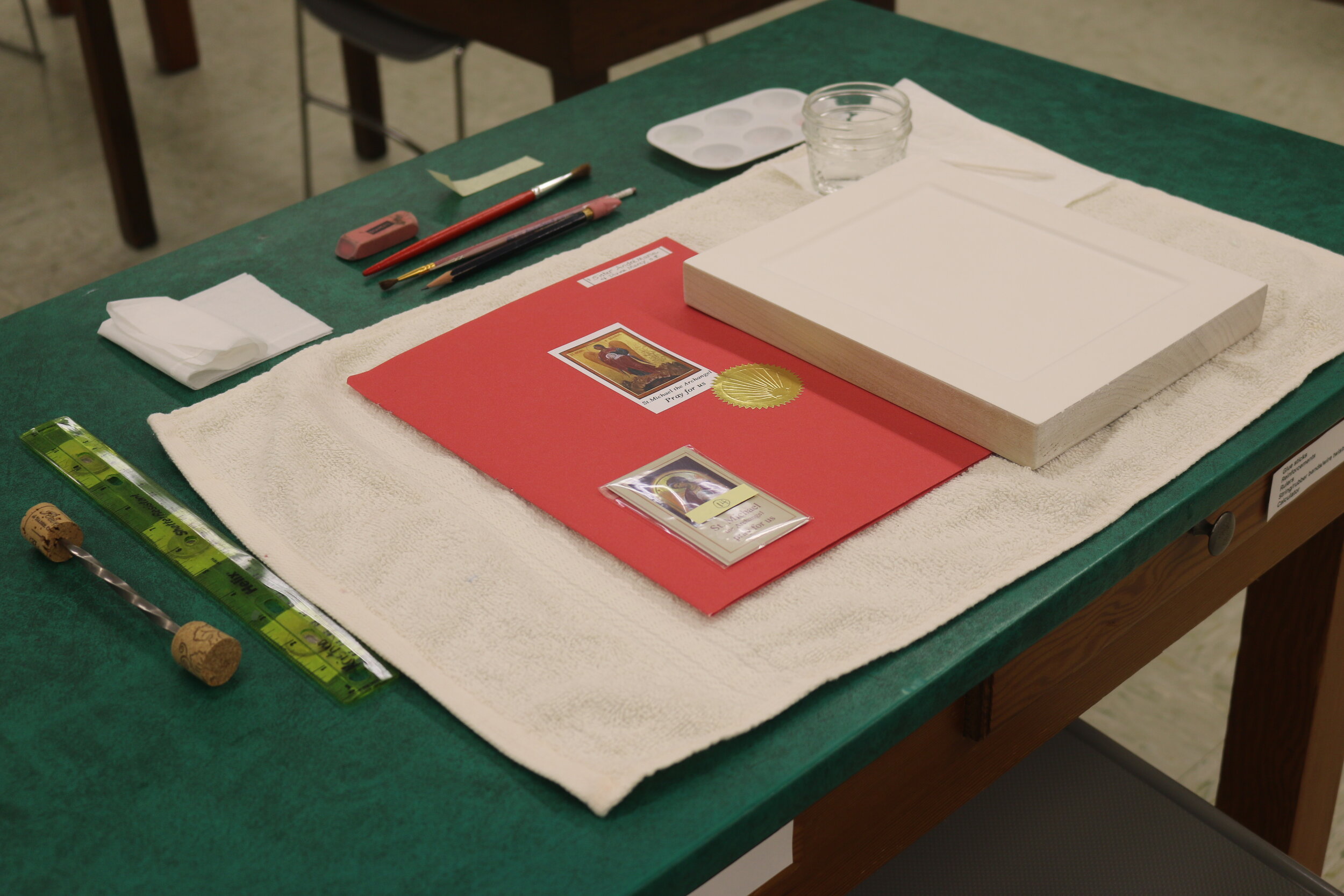
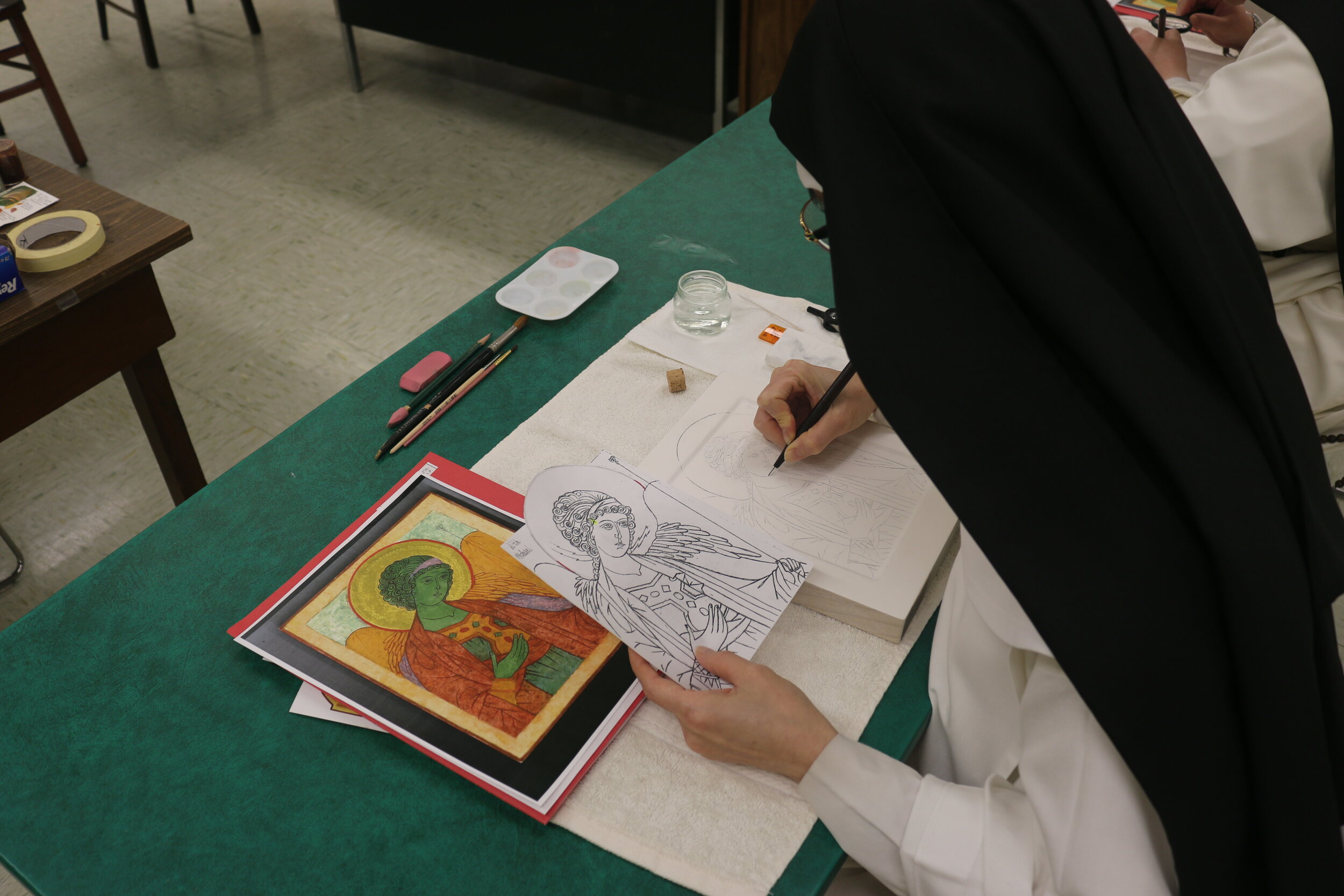
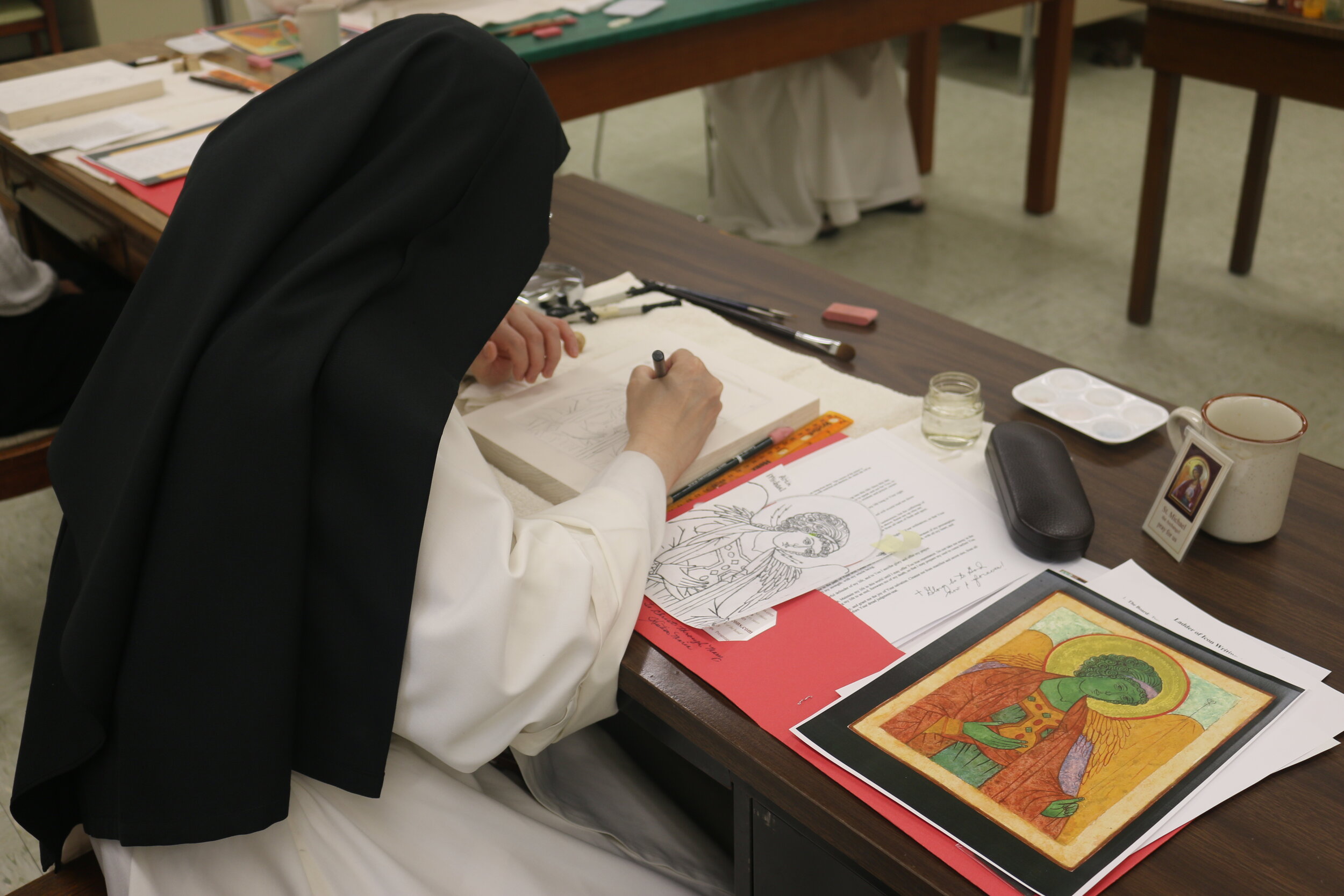
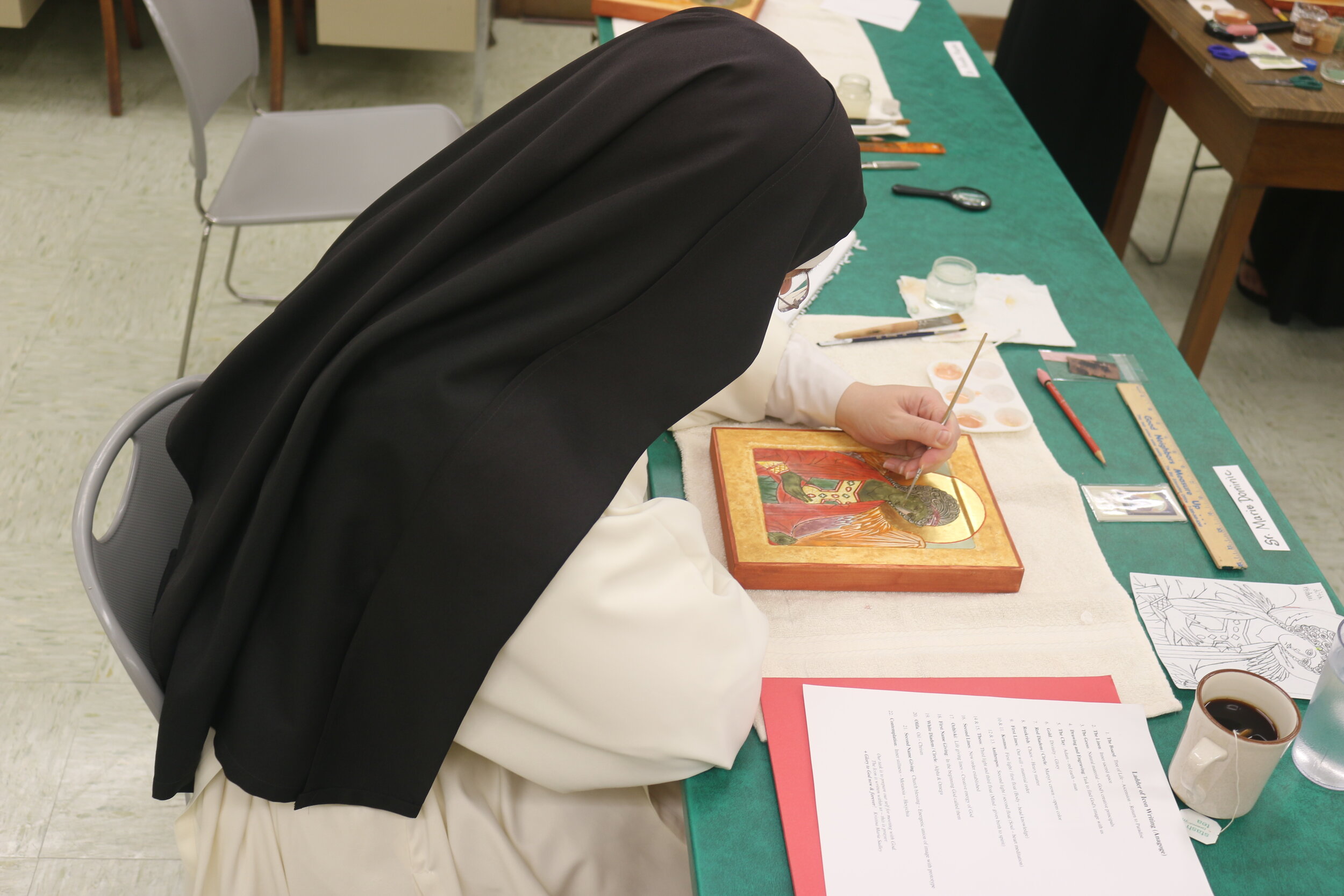
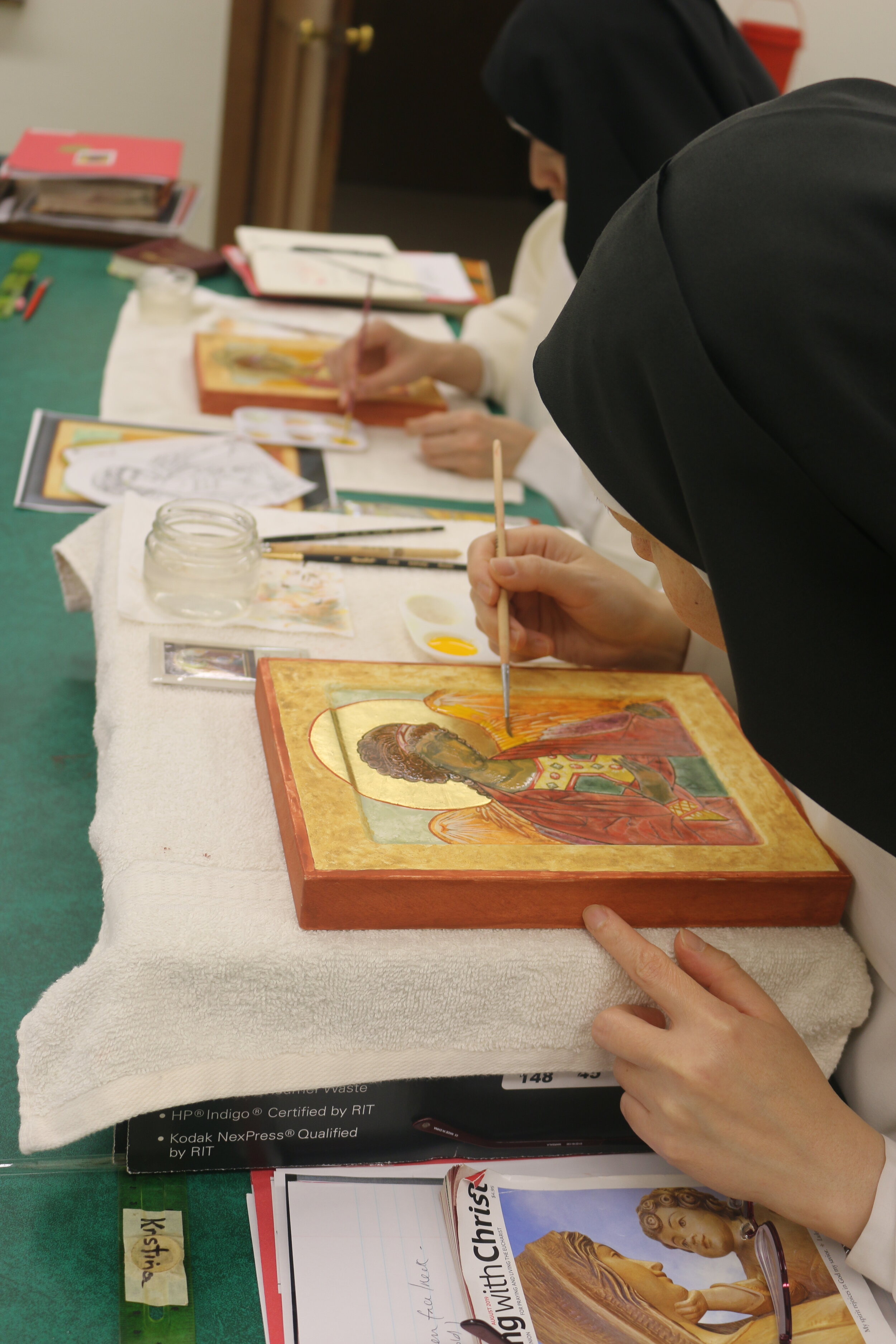
Last fall, our community had an extraordinary opportunity to begin learning an ancient form of prayer and preaching: iconography. Several of our younger sisters have had a desire to learn more about iconography (writing icons) and iconology (the study of icons) and, through the workings of Divine Providence and the generous support of benefactors, several sisters in our community spent a week in an intensive icon retreat with iconographer Kristina Sadley of Prophecy Designs Icons and an affiliate instructor for the Prosopon School of Iconology.
“Icon” is Greek for “image” and traditional icon writing is a prayerful discipline of hand, heart, and mind to bring forth the “Gospel in color” – every canonically written icon reveals Christ, and comes from within the iconographer and his/her prayer.
The week began with Mass, confession, and a blessing of our icon boards and our sister iconographers. Once in our “iconography studio”, we began each morning with prayer, giving glory to the Holy Trinity, asking for grace and illumination as we worked and interceding for those who would venerate the icons we were writing. Except for instructions, our time was largely spent in silence.
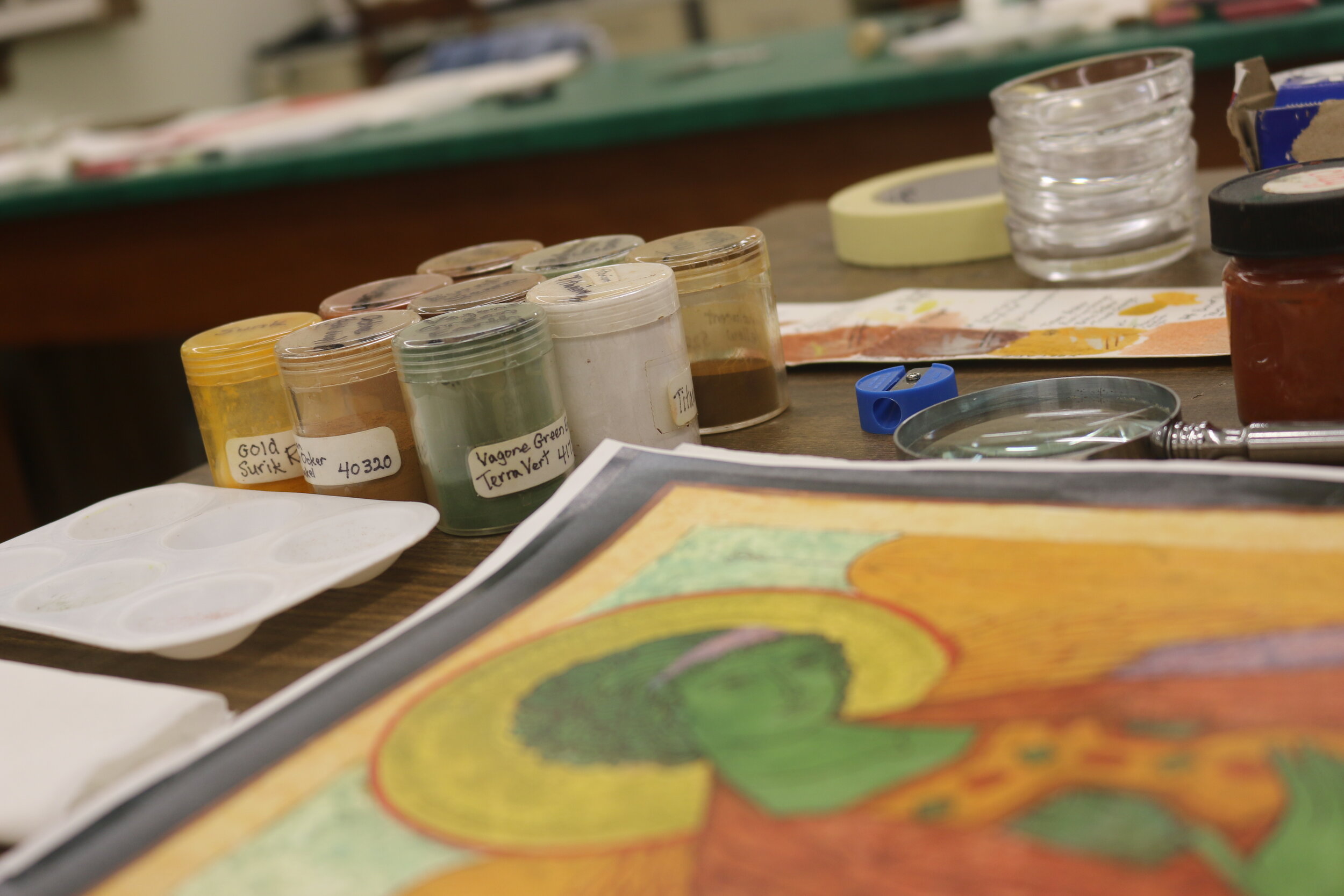
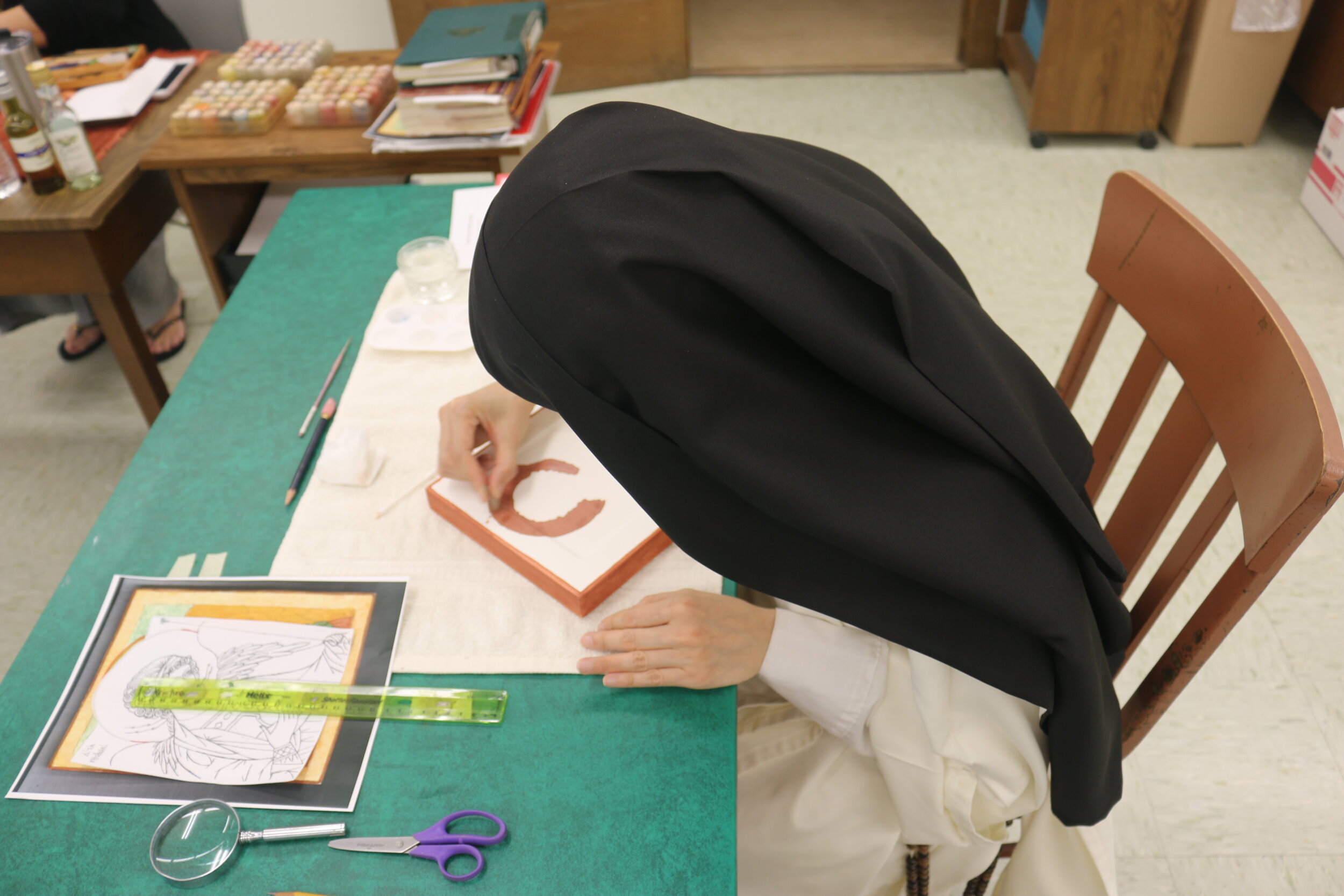
We quickly learned that everything in iconography has meaning and purpose – every feature, every color, every step in the process. For example, the wood of the board – a symbol of the wood of the cross; the whiteness of the board – purity and light. Our first step was to trace the image of our icon onto the board using carbon paper, then, once traced, we etched into the white gesso layers with a stylus so our lines would not be lost as we began to apply clay, gold and pigments. This parallels our own life when we receive the Gospel – lightly at first, but when we cooperate with God’s grace, He etches His Word into our hearts.
The next step was also profoundly meaningful to many of us – applying the clay bole and the goldleaf for the icon’s halo. The clay bole represents our humanity. The gold represents God’s glory and divinity. To have the gold adhere properly to the clay, the iconographer must get very close to the clay, with goldleaf piece ready in hand, and breathe deeply but gently on the clay to warm it, reminding the iconographer that God breathed life into Adam. After two or three breaths, the gold is quickly applied and pressed gently onto the warmed clay, and the iconographer moves to the next small section of the halo to begin again. Once the gold is applied, the first color is applied to the board – a bright red line is added to encircle the halo – the blood of Christ and the white has now been broken open into color.
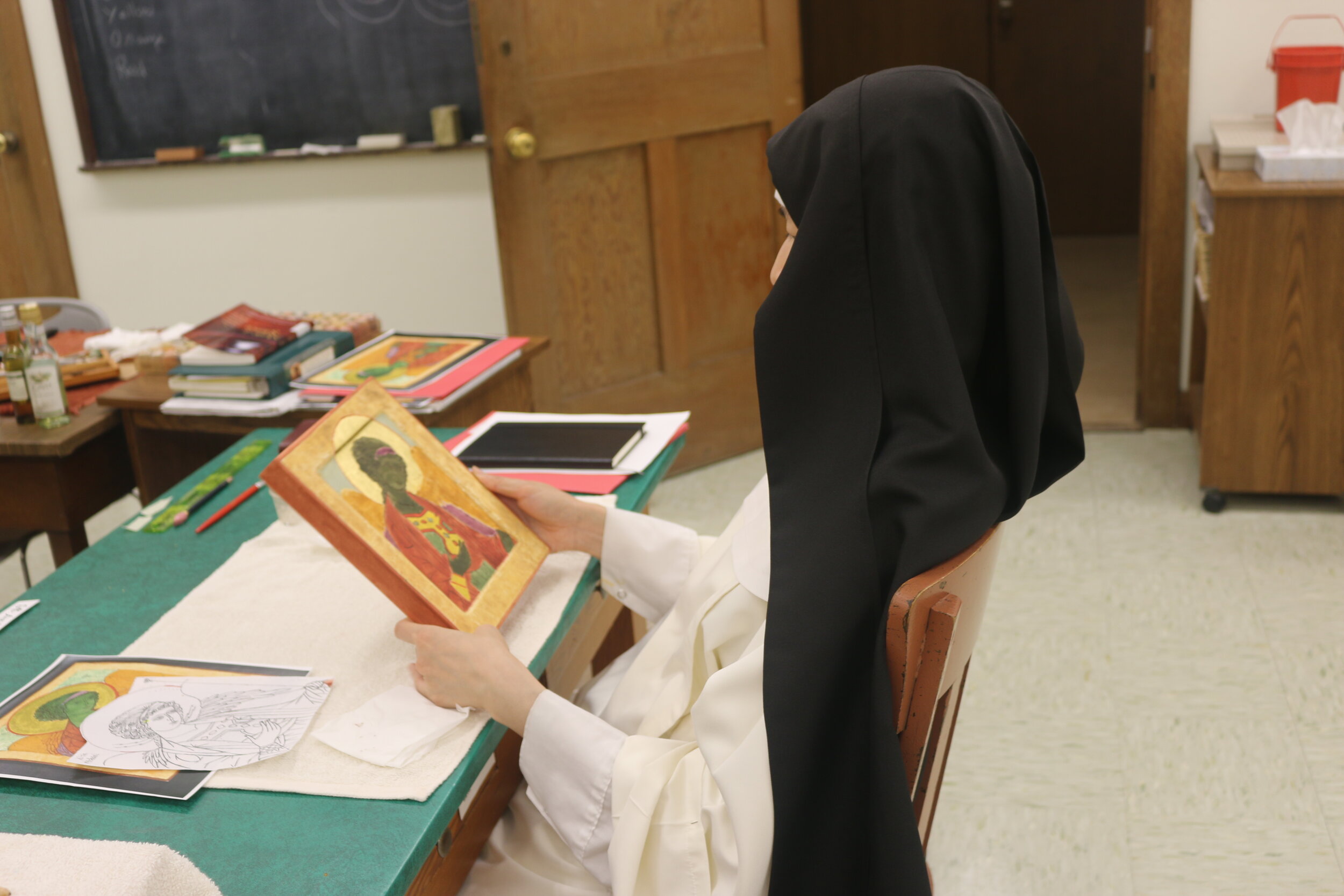
So by now you may be asking, “which icons did the sisters write?” Mary? Jesus? A festal scene? You may be surprised (as we were) to learn we had no choice about our first icon – we would all be writing Saint Michael. But then, Kristina explained why: iconography, as prayer, is a battle – it is spiritual warfare in a profound way. And so we begin with Saint Michael, who is prince of heaven and our help in spiritual battles against the devil. Saint Michael reminds us, “who is like God?” He helps us keep right perspective in humility and our eyes Christ. It is also for these reasons that an iconographer does not part with his or her first icon.
Our first icon completed, our new iconographers are making plans to begin writing their second icon, Saint Gabriel. As Saint Michael helps us grow in humility and clear out the sins and blocks in our hearts and lives to God’s grace, Saint Gabriel brings the Good News and helps us fill our souls with God’s goodness, truth, and beauty.
We give thanks to Kristina and our benefactors whose generosity opened the door for us to this ancient method of prayer and visual preaching of the Gospel. May Fra Angelico intercede for all artists and those who use visual means to promote the goodness, truth and beauty of the Gospel. Saint Michael, Saint Gabriel and Fra Angelico, pray for us!
Want to learn more about assisting our arts and iconography studio or other opportunities to support our cloistered Dominican life? Email us or visit our website. Thank you and God bless!

Bride of the Infinite Bridegroom: The Response
She has seen the things the world has to offer – many of them good things, created by God and which can lead people to knowledge and love of God. She has grown in knowledge and perhaps began exercising her talents and skills by means of her education, a career, in her parish and relationships with family and friends. Yet, her heart is not satisfied…
Part Two of the Portrait of a Cloistered Dominican Nun series. Click here for Part One.
The Dominican nun, having heard God call her to a vocation of love, longs to give herself completely to Him in love.
She has seen the things the world has to offer – many of them good things, created by God and which can lead people to knowledge and love of God. She has grown in knowledge and perhaps began exercising her talents and skills by means of her education, a career, in her parish and relationships with family and friends. Yet, her heart is not satisfied: she realizes that even these good things of life on earth are passing away. She desires to give herself completely to the eternal: Supreme Goodness in Truth and Love. And she burns with love for the souls around her who are wandering in darkness, without the light of Truth.
A Dominican nun sets herself to follow in the footsteps of our Holy Father Dominic, who first gave himself to God in a life of contemplation, and then was sent by God as a “useless servant” to preach the Gospel to those living in darkness.
The Dominican nun follows her Beloved into the desert and, in the example of Moses and Queen Esther, prays for God’s mercy and grace on behalf of lost souls. As her Beloved Jesus first expressed His thirst for souls while suffering on the cross, this desire burned in the heart of our Holy Father Dominic. A Dominican nun shares in this longing for souls and Dominic’s words continue to ring out toward heaven from the lips of his daughters and sons: “Lord, what will become of sinners?”
Look at a community of Dominican nuns and you will see all kinds of personalities, gifts and skills. Like a beautiful garden with a variety of flowers and plants, no two Dominican nuns are alike.
There is no one “type” of Dominican contemplative; you cannot look at a person and say he or she has a “natural disposition” for contemplation. Rather, the contemplative life is a calling to a life of love, of affective knowledge of God, that is, knowledge of the heart (as opposed to the intellect). God can impart knowledge of Himself through love to the heart, and it is this knowledge that forms the core of the contemplative life. It is aimed at eternal things, a supernatural life of grace and the living out of the theological virtues (faith, hope and love) in a radical way. In this way, it is a life at the heart of the Church, a lamp on a hill as a sign to all the faithful of the life to come.
The Dominican nun has an apostolic heart and participates intimately in the holy preaching of the Dominican Order.
There are many kinds of preaching: catechetical, apologetics, and so on. But holy preaching is the essential function of the contemplative life. Holy preaching unveils the mysteries that are the objects of the faith and presents them as nourishment to the faith; it is divine because God uses the preacher as His instrument. Holy preaching is a gift from God and as such, the preacher must content himself or herself to wait on God and be used at His pleasure, in His own way and time. Jesus’ life was one of holy preaching. But it was not until after Pentecost, when the disciples had experienced the silence of contemplation with the Blessed Virgin in the Cenacle, that the Spirit came upon them and sent them forth to preach.
A Dominican nun waits in silence and preaches as Mary – most often in her life of prayer and silence.
Sometimes she preaches through a word of encouragement to her brothers and sisters, and the faithful with whom she comes in contact. And always her example speaks volumes as it shows forth our dignity as children and spouses of the triune God.
Want to learn more about how to discover the gifts God has given you and about cloistered, contemplative life as a Dominican nun? Check out our resources for discernment on our website and contact Sister Joseph Marie with any questions or to arrange a visit to learn more.

The Encounter Moment
We’ve seen it played out countless times in our imaginations and on-screen: two people going about life as usual, but then, they catch each other’s glance. The world around them fades away as they stop and look at the other. An ordinary moment is made extraordinary by an encounter with the other, and the course of their lives changes. Do this life-changing moment really happen? Can they happen to us? Yes!
We’ve seen it played out countless times in our imaginations and on-screen: two people going about life as usual, but then, they catch each other’s glance. The world around them fades away as they stop and look at the other. An ordinary moment is made extraordinary by an encounter with the other, and the course of their lives changes. Of course, with Hollywood, this is usually a “love-at-first-sight” moment and the skeptics among us scoff that such things actually happen in “real life.” But before we snicker, flip the page or walk away, let’s consider the story of Simeon and Anna in the temple and whether there’s something to such a life-changing encounter moment.

By Fra Angelico - John Pope-Hennessy, Beato Angelico, Scala, Firenze 1981., Public Domain
Simeon and Anna, along with all of Israel, had been waiting, longing, for an encounter with the Messiah. God had brought humankind, and in particular the Jews, through a long, often difficult road of preparing them for the coming of the Messiah. Simeon had even been assured by the Holy Spirit that he would not die before seeing Israel’s savior. And then, the day came. He went to the temple as usual. He saw a young couple enter with a baby boy, a first-born son to be consecrated to God, like every other first-born baby boy. Yet this one was different. Simeon saw and he knew. In this encounter moment, his life was complete and he praised God saying, “Now you may let your servant go in peace, your word has been fulfilled.” Anna, too, came forward in that moment and began prophesying and telling everyone about this little baby boy. One encounter, one moment, changed everything for them.
But surely Simeon and Anna were different; does God really work like that today? Actually, Jesus often comes to us small and quiet, like he did when he was an infant at his presentation in the temple. Think of how many people were in the temple that day, yet Simeon and Anna were the two that were given knowledge of his true identity – that he was the Messiah everyone there was waiting for. If we want to recognize Jesus when he comes to us, like Simeon and Anna, like Mary and Joseph, we must be prepared to receive Him. We must watch with expectation.
On the feast of the Presentation of the Lord (celebrated in the Eastern Churches as “The Meeting”), we processed into the church with lighted candles, “eager to carry [them] in praise of [God’s] name.” We heard the reading from the Old Testament, the promise of the coming of “the Lord whom you seek”, who is like “the refiner’s fire, or like the fuller’s lye”. And we, the people of God respond with the responsorial psalm:
Oh gates, lift high your heads!
Reach up you ancient portals,
that the king of glory may come in!
The verses of the responsorial psalm, part of Psalm 24, was composed for solemn liturgical procession. The psalm describes the attitude of those who would approach the temple. It is a psalm declaring God as king, triumphant over all His enemies. Today, Jesus does not enter a temple made with human hands – we are his temple: he desires to be enthroned in each and every heart, to reveal his triumph over sin and death in each of our lives. We “lift high the gates” when we open wide our hearts and make room for him. The ancient doors of our humanity grow higher when we wait with our candles of faith and hope lighted, burning with the virtues and charity, and we long with expectation for our own encounter with Him, listening for His voice.
After hearing Him in the readings, and offering Him our response of receptivity, he comes. He comes and gives Himself wholly and completely in the Eucharist. He comes, hidden under the appearance of bread and wine, but he is here – body, soul, blood and divinity. To see, we must look with the eyes of faith. To receive, we must lift up our hearts to him in hope and thanksgiving. At this moment, the moment of communion with our God and King, the Church gives us the words of Simeon as our own: “My eyes have seen your salvation, which you prepared in the sight of all the peoples.”
Were we prepared for our encounter moment with him? Perhaps at this moment of life, our cups overflows with goodness, beauty and riches? Let us give thanks to God who has given us these things. Perhaps life is a bit blurry, full of questions or we are uncertain about the future? Then we can stand with Mary in the temple as she hears Simeon foretell that “a sword will pierce her heart”, yet she cannot fully grasp the meaning of those words in that moment; she keeps them in her heart and ponders them as she walks through life by faith. Or perhaps at this moment in our life, we are in the darkness of a Garden of Gethsemane, or even nailed to the cross, experiencing deep pain, abandonment, helplessness. In each of these moments of life, HE COMES.
Let us celebrate the coming of our King and Savior! He has come, he will come again, and he continues to come at this moment, if only we will surrender to Him in trust and open wide to let Him enter. May the Church’s prayer after communion on the Feast of the Presentation of the Lord be our own throughout this week:
By these holy gifts which we have received, O Lord,
bring your grace to perfection within us,
and, as you fulfilled Simeon’s expectation
that he would not see death
until he had been privileged to welcome the Christ,
so may we, going forth to meet the Lord,
obtain the gift of eternal life.
Through Christ our Lord.

Five Takeaways from our January Come-and-See
Did you miss our January Come and See Day? While we can’t share everything about the day in one blog post, here are five takeaway-points given to us by our speakers: Father John Marie Bingham, O.P., Sister Mary Isabel of the Angels, O.P. and Brother Athanasius Thompson, O.P.
Did you miss our January Come and See Day? While we can’t share everything about the day in one blog post, here are five takeaway-points given to us by our speakers: Father John Marie Bingham, O.P., Sister Mary Isabel of the Angels, O.P. and Brother Athanasius Thompson, O.P.
Before we can say “yes” to God’s will, we must lay a foundation of trusting in Him. Father John Marie advised the young women present to pray frequently, “Jesus, I trust in you.” Only when we trust in God’s goodness and love toward us can we also have the courage to do His will when he calls us to act.

A few of our sisters sitting in on Father John Marie’s talk.
Before we can tell God, ‘yes, I will follow your will’,
we have to trust Him
and that His will is for us to be truly happy.
The fact that you are here, that you took the step of coming today,
is proof of your trust in Him and His goodness and love for you.Father John Marie Bingham, O.P.
Saint Dominic modeled for his sons and daughters a life of Gospel simplicity and nobility. How do we live this in our own lives? Father John Marie offered and explained five steps: earnestly ask God for mercy; sit at His feet and listen to Him; live as He lived; do what He did - go to the cross; and then go and preach the Gospel.
God will sustain our efforts in our given vocation. Whatever vocation God is calling you to, only His grace and strength will make it possible for you to be fruitful in it. All we have to do is receive the grace and respond with our “yes” - He will take care of the rest.
Religious life is a school of perfection. In other words, perfection is not a requirement for entering religious life - it is by living religious life in cooperation with God’s grace that we are made perfect.

Brother speaks on Dominican life.
As Dominicans, we participate in a rich spiritual and intellectual tradition for the mission of salvation of souls as part of the Dominican family. Sister Mary Isabel and Brother Athanasius shared about Dominican contemplative life, including how and why Dominicans stress community/common life and study. Dominican intellectual life is aimed at knowing God so we may love Him more; Dominican community/common life mirrors the Church in that the Dominican Order is truly a body with many parts.
I felt a great connection to the community and sisters, the prayer,
and description of life here. I would love to be in touch more about “what next”
- what I can or should do to continue discerning and learning…Come and See Day Participant
Our deepest gratitude to Father John Marie, Brother Athanasius, and to all those who kept us, and the young women in attendance, in prayer. Please continue to offer your prayers for them (and us!) as they continue seeking God's will for their lives.
Our next Come and See Day is Saturday, July 18th and we already have young women registering. If you or someone you know has put off taking the next step in discerning God’s will, say a prayer of trust and make a commitment today to simply “Come and See!” For more information about our Come and Say Days, and our Janua Caeli Retreat Days, or to register for either event, visit Retreat Days on our website.

Is He Calling You?
At the beginning of the New Year, the Church also steps into the “ordinary time” of the Liturgical year. In the Gospel of this first day of this ordinary time, we see our Lord began his ministry and gave his very first homily: “This is the time of fulfillment…
Happy 2020!
At the beginning of the New Year, the Church also steps into the “Ordinary Time” of the Liturgical Year. In the Gospel of this first day of this Ordinary Time, we see our Lord began his ministry and gave his very first homily: “This is the time of fulfillment. The kingdom of God is at hand. Repent, and believe in the Gospel.” (Mark. 1:15)

Jesus was not a lone ranger. No! To help him with the preaching mission, Jesus began calling the first disciples after spending days in prayer and being baptized for the mission. We are told that as Jesus passed by the Sea of Galilee, he called Simon and his brother Andrew. And Peter and Andrew “abandoned their nets and followed him” (Mark 1:18). Going a little further, Jesus called James and John and they “left their father Zebedee in the boat along with the hired men and followed him” (Mark 1:20).
These men were busily engaged in their profession and helping their families at the prosperous trade of fishing. Yet when Jesus called, they immediately left everything and everyone behind to follow him. Why? They certainly were neither poor nor desperate. On the contrary, they seemed to have given up A LOT!
These disciples were able to (immediately) give up all the good things in life because their deepest desire was for God and God alone. When Jesus called them, the disciples sincerely and humbly acknowledged their thirst for God and accepted Jesus’ invitation. By doing so, they allowed God to fill them more than they could ever imagine…His very self. Peter affirmed this happiness later on when Jesus gave his disciples a chance to leave him: “Master, to whom shall we go? You have the words of eternal life.” (John 6:68)
Is He calling you? Have courage and respond! There are still rooms available and time to register for our Come and See Day this Saturday, January 18th; visit our Upcoming Events page for more information and to register.

Rev. John Marie Bingham, O.P.
Our participants will be given tools to help them discerning vocations, and opportunities to meet the nuns and those who are also discerning their vocations. Our guest speakers are Rev. John Marie Bingham, O.P., vocation director of the Western Dominican Province and Brother Athanasius Thompson, O.P. of the Western Dominican Province.
Please pray for our speakers and the young women who will be coming to our monastery discernment day this Saturday, January 18th and for all those who are called to share more intimately in the preaching mission of Jesus Christ.

Bride of the Infinite Bridegroom: The Call
Throughout the Christmas season, we are lavished with reminders of God’s love and compassion for us. He loved, and still loves you, into being, and he has called you to live in communion with Him. But what does that mean for your life? Do you know which vocation to love God has called you?
Part One of the Portrait of a Cloistered Dominican Nun series.
Throughout the Christmas season, we are lavished with reminders of God’s love and compassion for us. Every person is loved into existence. Even those that, from an earthly perspective may seem unwanted, uncared for, the fact remains that before their flesh took form in their mother’s womb, they were thought of by God, down to the number of the hairs on their head, and God loved the idea of that person so much, He gave that person existence.
You, who once did not exist, now live and breathe because God wants you to be. He loved, and still loves you, into being.
And He does not simply sit back and watch the world unfold. He does not casually watch us as we would watch a movie, rooting for the good, booing the bad, crying with separated lovers and rejoicing when things end happily ever after. No, it is a great mystery how He works in human history, for our history is truly His story, and still He still respects our freewill to either cooperate with His graces or not, to love Him or spurn Him. Saint Catherine of Siena called Him a “mad lover,” because He does everything with precision to woo us and show us the infinite good that He is and offers us.
This is the Christian vocation – to know Him, to love Him, and to serve Him, He who is infinite good. In that sense, every single Christian is called to contemplation.
But there are some people He chooses to woo most directly. From the beginning of time, He saw these souls and was enamored by them, and chose them to be set aside, consecrated, just for Him. He would make them His Spouse while they were yet on earth. Within this calling to a contemplative life as the Spouse of Christ, He further invites them to share in His heart, in His love, in a particular way – that is, the charism of the Order to which He calls them.

The Dominican Order was founded by Our Holy Father Dominic with the mission of preaching for the salvation of souls. During his days, Dominic joyfully gave himself freely to his brothers and sisters, encouraging and teaching them in holiness, and to his neighbors preaching the Gospel. He studied and contemplated God’s Word and sacred truth so that he might share with others the fruits of his contemplation. During the night, he spent himself in prayer, giving God praise and adoration, and interceding for the people. Periodically, he could be overheard crying out in prayer: “Lord, what will happen to sinners?” In the example and instruction of our Holy Father Dominic, Dominican life is based on the four pillars of Prayer, Study, Community, and Preaching; its mission has two intertwining parts: to give praise and glory to God and for the salvation of souls. A Dominican nun shares in this priestly and apostolic heart.
As Mary watched over the Church in the upper room at Pentecost, praying with and for them, and then the disciples were filled with the Holy Spirit and went out to preach to the people, a Dominican nun spends her life in praise, prayer and sacrifice for the preaching work of the Dominican Order and the salvation of souls.
A cloistered Dominican nun is inseparably joined to the entire Dominican family and continually offers praise, prayer and sacrifices on their behalf. As the ground must be softened by water so that the seeds sown in it will grow, a Dominican nun remains at the feet of her Beloved, Jesus, contemplating Him; she does this so that the Gospel preached throughout the world would not return to God empty, but may accomplish those things for which it was sent. If we do not first pray for the Holy Spirit to rain down on hearts hardened by sin and self-love, how can the seeds of the Gospel sown by the preacher take root, grow, and bear fruit?
Want to learn more about how to discover the gifts God has given you and about cloistered, contemplative life as a Dominican nun? Then you don’t want to miss our “Come-and-See” Day - Saturday, January 18th! Visit our Retreat Days page or email our vocations directress, Sister Joseph Marie, O.P. for more information and to register.
![To Be[come] a Preacher](https://images.squarespace-cdn.com/content/v1/5a32b42d9f8dce05dea5bcea/1575139765054-K4P3II8VNZUQRVHJS31C/to+be%5Bcome%5D+a+preacher_+monastic+theological+studies+in+texas.png)
To Be[come] a Preacher
Why do we study? To know better He whom we love. This past summer, our sisters-in-formation headed to Lufkin, Texas to begin a four-year study program in philosophy and theology. In this post, they give a description of their experience and impressions.
Our Monastery of Corpus Christi in Menlo Park, California was still wrapped in the stillness of night as we four sisters-in-formation made our way to the choir for a visit with Jesus, then slipped quietly to the kitchen. Our novice mistress and another sister were busy preparing sack lunches and a good breakfast of eggs and toast to send us on our way. Hugs and good-byes exchanged, we loaded up into the waiting van and headed to the San Francisco International Airport to catch a flight to Houston, Texas, where we would meet five other sisters-in-formation from across North America. Our ultimate destination was the Monastery of the Infant Jesus in Lufkin, Texas - a two-hour drive from Houston - to begin our first year of the Monastic Theological Program with a two-week session of classes in Philosophy and Theology.
Monastic study is not like studying for school or a career - we study God and the things of God to know Him better so we might love Him more, and more effectively share Him with others.

The Monastic Theological Program, or MTS, is offered by the North American Association of Dominican Monasteries (NAADM) for nuns who have professed, or will shortly profess, simple vows. It is a four-year program of philosophical and theological studies intended to introduce the nun-in-formation to more advanced study that we can then pursue for the rest of our monastic life. Each year begins with a two-week session of intensive classes taught by Dominican friars. This year, the first week was an introduction to philosophy taught by Father Brian Chrzastek, O.P. of the Province of Saint Joseph; the second week was an introduction to theology taught by Father Philip Neri Powell, O.P. of the Province of Saint Martin de Porres. After the two-week class session, we return to our own monasteries to “unpack” what we received, write topic papers, and prepare presentations to be given to our classmates at the following year’s two-week session. But MTS is more than just a program to sharpen our Dominican pillar of study. It also provides exciting opportunities for a nun to grow in the pillars of prayer, community and preaching.
Through the Monastic Theological Studies program, nuns-in-formation share a valuable experience of Dominican life in other monastic communities and begin building community with one another.
For this four-year cycle of MTS, four monasteries of NAADM sent sisters-in-formation to participate: one sister from the Monastery of the Infant Jesus in Lufkin, Texas, one sister from Queen of Peace Monastery in British Columbia, Canada, three sisters from the Monastery of Our Lady of the Rosary in Summit, New Jersey, and four from Corpus Christi Monastery, in Menlo Park, California. Those of us who traveled from the other three monasteries, traveled an average of 1,960 miles, or 3,110 kilometers. That’s farther than driving from Rome to Moscow!

For most of us, this was the first time we’d visited another Dominican monastery other than the one we entered. And, because our homes and monasteries are situated in vastly different regions of North America, we also have different cultural experiences and ways of expressing the values of Dominican life. Some of our monasteries are older (for North America) and were built in in a more classic European monastic style, with stained glass windows, an enclosed cloister, Gothic arches and other architectural details. Other of our monasteries were built more recently, in a more modern architectural style, and have taken into account resources available and the contemporary needs of the local community. Our respective horaria and details in observances also reflect the needs of our respective communities. So it was an enriching experience to see Dominican values lived in another monastery and hear stories from one another about each other’s home monastery.
One of our first activities was to take a tour of the monastery and meet some of the sisters. We delighted to see and learn how many things were the same as “home” and intrigued by differences. It wasn’t uncommon to hear as we went, “oh, that’s a great idea!” or, “this is how we have this arrangement, etc.” We also grew eager for the opportunity to see another of our four monasteries – next year, the community at the Monastery of Our Lady of the Rosary in Summit, New Jersey will host the MTS classes.
But beyond architecture and the structure of the regular observances, the two weeks gave us a wonderful and unique opportunity to meet and begin to form bonds with each other. While our monasteries are autonomous, no monastery exists in a vacuum - we relate to one another and share with one another our time, talents and resources primarily through our association membership. Recently, the pope and our Master have emphasized the increasing importance of interdependence between monasteries and the developing role of Federations/Associations. Naturally, if we are to effectively share the fruits of our contemplation with each other and provide needed support and collegiality, we first need to know and begin to understand one another. Our MTS experience also gave us the opportunity to concretely realize “I am not alone.” That is, there are other sisters-in-formation who are experiencing the same difficulties, challenges and blessings that come with being formed as a Dominican nun.
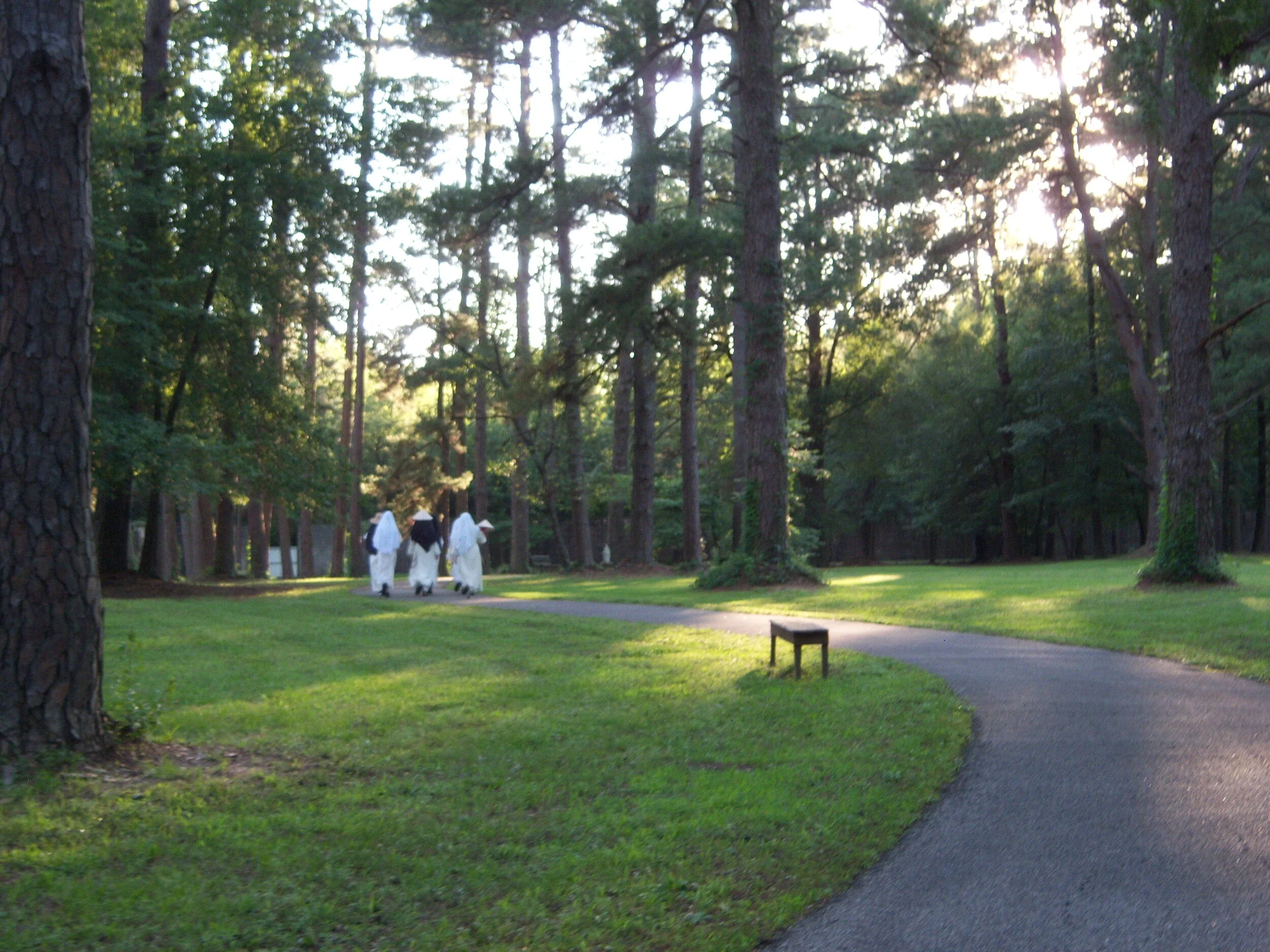
When a young woman enters a monastery as a postulant, it is expected there will be a learning curve, especially at community prayer - when to bow, when to knee, sit, sing - everything is governed by certain rubrics that can vary from monastery to monastery. And so, our first time in choir for liturgical prayer was, in some ways, like returning to the postulancy. The content of the prayer, naturally, was the same, but the intonations, and the details of the way the prayer was expressed was different for most of us –the configuration of the choir, the procession flow for communion, using English versus Latin for some of the hymns and prayers, etc. The hosting community was exceedingly gracious in providing us the guidance we needed to participate more fully and soon we were, more or less, in the flow of things again.
All this gave us an opportunity to deepen our understanding of the essential values of Dominican life versus structures that can and should be adapted to time and culture. It was a beautiful experience to enter into the life of the hosting community, as much as our classes and studies would allow, and live Dominican prayer in that place. Ultimately, we can begin to see how much more we share in common than what we have in differences.
A Dominican nun’s first preaching is in her fidelity to the vows and Dominican life, which reveals the reconciliation of all things in Jesus.
We sisters-in-formation were the recipients of the most sublime preaching of our Order – the reconciliation of all in Christ. For we were welcomed with open arms, with hearts full of love (and as big as the Texas skies), and hands eager to serve and make us comfortable. We preached to each other with our common sharing and examples of preserving silence and prayer, despite our being out of our element. And we preached to all those we met along the way – the active Dominican sisters from Puerto Rico who were serving in the area and a Dominican friar from India who chanced to visit while we were there; the people in the airport and on the planes who couldn’t help but notice a group of nuns in full habit and who were eager to share their stories and ask for prayers, and many more along the way that we shall never know.
“We are preachers. It’s not what we do; it’s who we are.”
Our newly elected Master of the Order, Father Gerard Timoner, O.P., recently emphasized that “we are preachers”. It is not what we do, it is who we are. The whole experience of MTS takes a vital step in forming the cloistered nuns of North America into the preachers Jesus is calling us to be for our generation and world today.


Celebrating 25 Years, a Bride of Christ (and a New Book)!
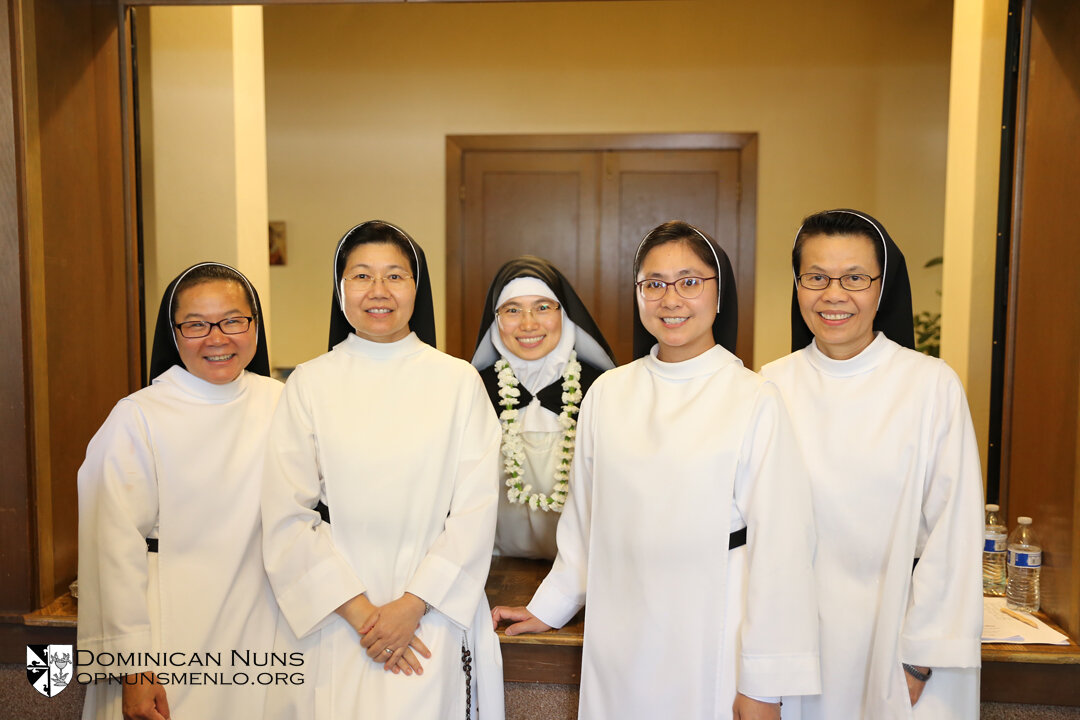
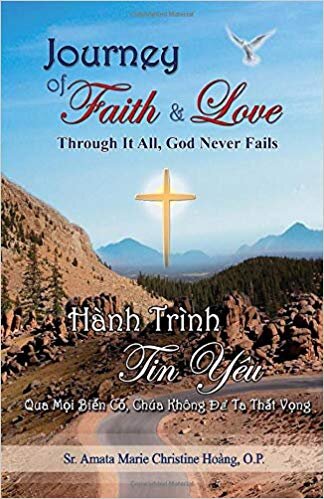
Recently, we had the privilege of celebrating with Sister Amata Marie her 25th anniversary of profession of vows…And we also celebrated with Sister Amata Marie in another way: with the release of a new book, Journey of Faith and Love: Through It All God Never Fails.
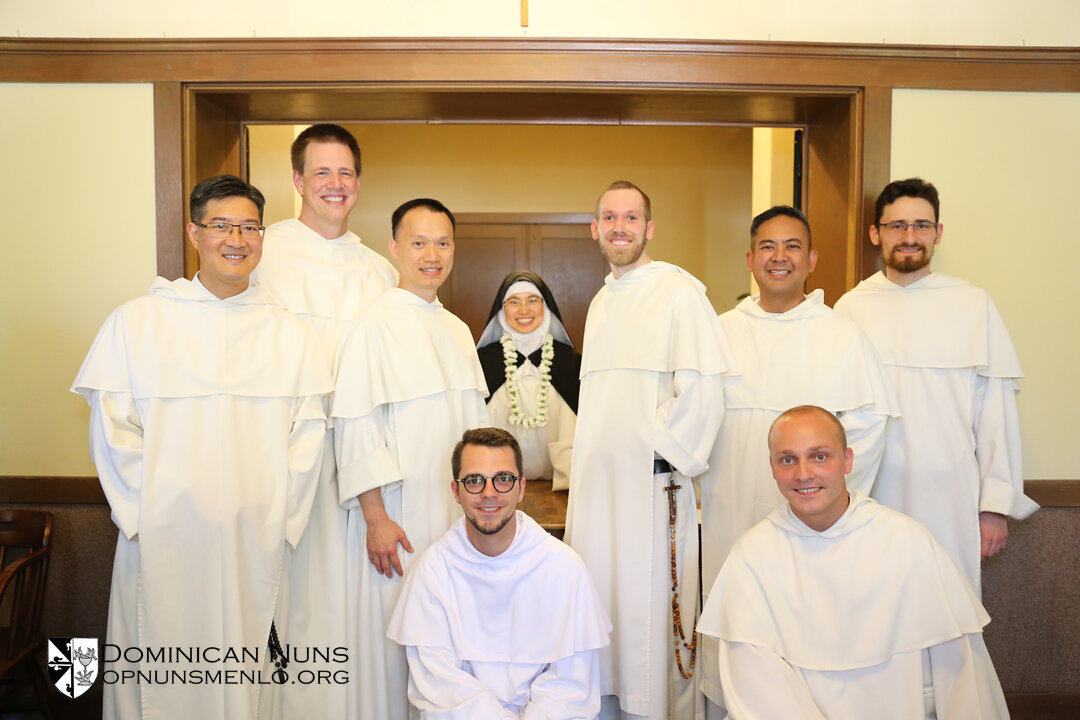
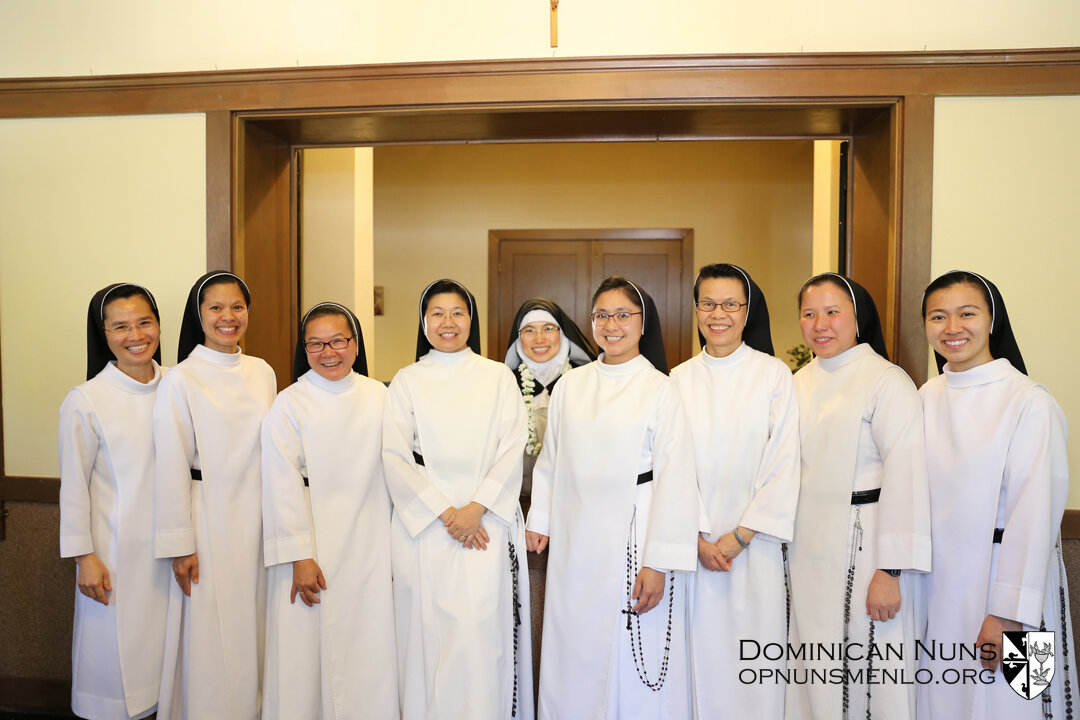
There’s nothing like celebrating a first profession: the youthful joy and excitement of the bride-to-be, the busy preparations of the community as they help her prepare for the big day. In some ways, it is like a fairy tale, a divine fairy tale. But even more beautiful is to celebrate a milestone anniversary with a bride of Christ. And recently, we had the privilege of celebrating with Sister Amata Marie her 25th anniversary of profession of vows.
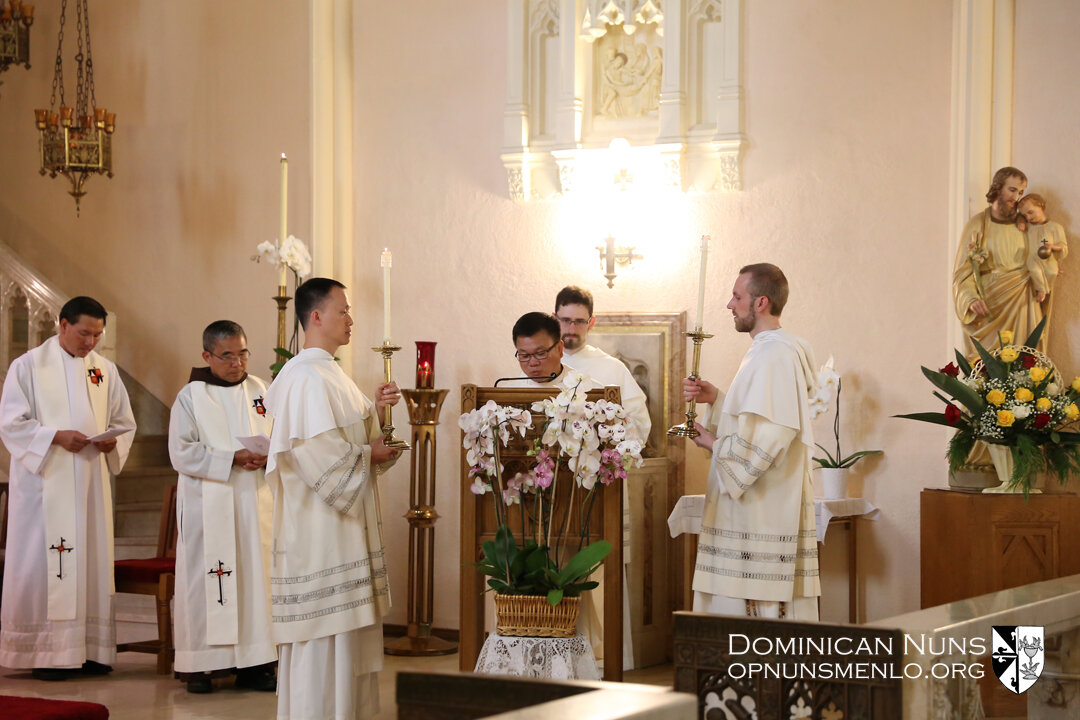
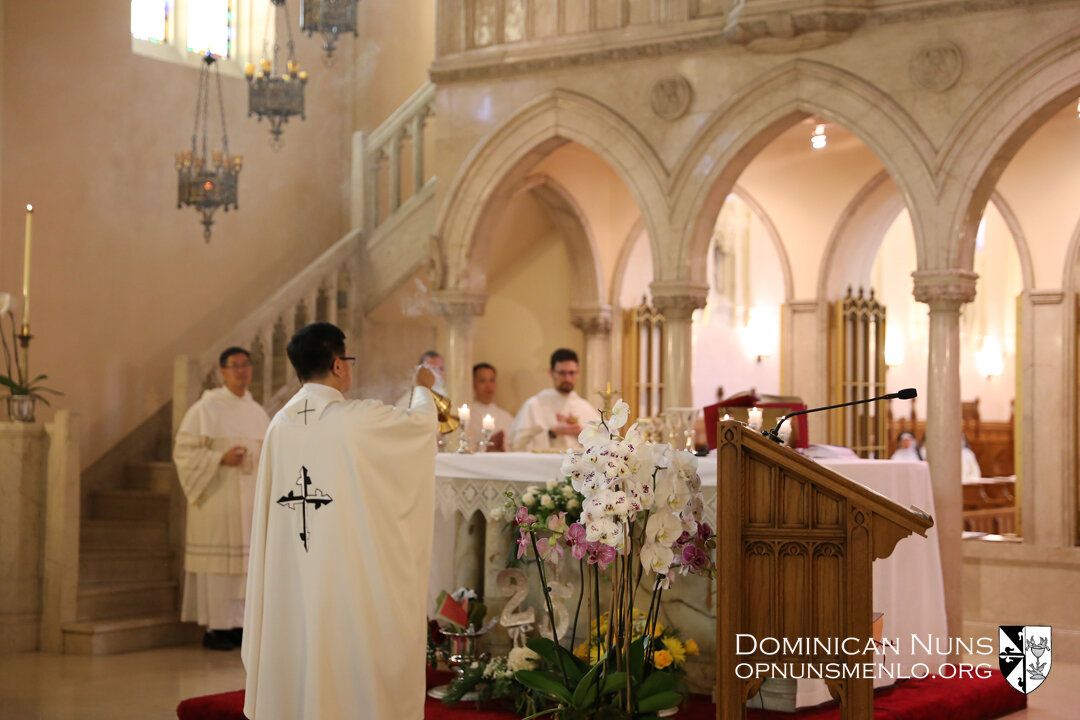
Sister Amata Marie comes to our community from life as an apostolic sister of the Dominican Sisters of Mary Immaculate Province in Houston, Texas. It was as a sister of this congregation that she first professed her religious vows. And we shared her joy as most of her classmates, as well as family and friends, were able to join us at our monastery to celebrate Mass for her jubilee. It was a truly catholic celebration as the languages heard during the Mass were three: Vietnamese, English and Latin, and elements of Vietnamese culture blended seamlessly with customs more familiar to American Catholics. Afterward, guests were treated to a sumptuous Vietnamese feast, generously hosted by Sister’s family.
A jubilee anniversary celebration reminds us of the grace that is needed daily to persevere in this, or indeed any, vocation. We all recognize souls who have stood the test of time and cooperated with this grace. They have been tried by the fire of trials and sufferings, cooled by the waters of peace and joy, and hammered and sculpted until the most beautiful forms have begun to take shape. We say begun, because as a jubilarian will be the first to say, their journey is not yet finished. But those of us who surround such souls rejoice at their example of perseverance and the fruitfulness they bring to their communities and the entire Church.
We also celebrated with Sister Amata Marie in another way: with the release of a new book, Journey of Faith and Love: Through It All God Never Fails. The book, written in both English and Vietnamese, features 26 chapters of reflections based on Sister Amata Marie’s life and experiences: from her childhood in Viet Nam and her time on a fishing boat adrift in the South China Sea as she escaped, to her life as a religious sister amidst her newfound freedom in the United States. Sister Amata Marie shares with readers her insights as she sought deeper intimacy with our Heavenly Father, and her experiences of loss and suffering, as well as moments of great peace and joy.
“My hope in sharing these experiences is that, as my own faith is strengthened, the faith of others may be strengthened as well,” says Sister Amata Marie. “God’s love is constantly pouring down on us every moment of our life. All we need to do is be open to receive it. Through this book, I hope that those who read these reflections will also recognize God’s constant presence in their own lives and the love God has for them personally, even if they don’t always feel it.”
Journey of Faith and Love is available in paperback on our gift shop website and in paperback and Kindle format on Amazon.
May God continue to bless and protect Sister Amata Marie and her profession class as their continue their lives of love and service as brides of Christ, and may our Beloved Savior raise up new brides to the glory of God and the proclamation of His Kingdom. Deo gratias!